How Much Does Collision Repair Cost in San Antonio

How Deductible Assistance Can Save You Money on Collision Repair
A collision can leave you feeling shaken and overwhelmed. The sight of your damaged vehicle adds immediate stress about the cost and process to fix it.
Here in San Antonio, you have a powerful right. You legally get to choose where your vehicle is fixed. This knowledge is your first step toward taking control of the situation.
Navigating the requirements from your insurance company can seem complex. Filing your insurance claim auto repair request correctly is crucial. It helps protect you from a significant financial burden.
This guide provides the essential steps to manage your vehicle’s restoration. You can ensure high-quality service and get your car back safely on the road. For a deeper dive into the entire process, review our detailed guide on handling these.
Key Takeaways
- After an accident in San Antonio, you have the legal right to select your own repair facility.
- Properly filing your claim is key to minimizing your out-of-pocket expenses.
- The process involves communicating with your insurer and your chosen shop.
- Selecting a reputable, professional auto repair center ensures quality results.
- Being informed helps you navigate the steps confidently and efficiently.
- Understanding your policy and documenting everything are critical best practices.
Understanding Your Insurance Policy and Coverage
Knowing exactly what your plan includes empowers you to navigate the next steps confidently. Your agreement details your financial protection.
Clarifying Policy Details and Limitations
Not all auto insurance coverage is the same. Two primary types handle vehicle damage. State laws and lender requirements shape your policies.
| Coverage Type | What It Does | Common Requirement |
|---|---|---|
| Liability | Covers damage you cause to others’ property or injuries. | Required by nearly every state. |
| Collision | Covers damage to your own vehicle from a crash. | Not state-mandated, but often required by lenders for leased or financed cars. |
Review your documents to see which types you carry. This determines if your policy pays for your car’s restoration.
Knowing Your Rights After a Collision
You hold important legal rights. First, you have the right to select any facility for the work. A company cannot force you into their network shop.
Second, understand your parts rights. Some policies mandate original manufacturer parts. Check your limitations to ensure quality.
Knowing these rights protects you from pressure. You can demand proper service for your vehicle.
Steps to File an “insurance claim auto repair” with Confidence
The moment you decide to file a claim, effective communication becomes your most important tool. This procedural step requires preparation to ensure a smooth process.
Contacting Your Insurance Company Effectively
You can start the process by calling your provider directly. For example, State Farm clients can contact a claims associate at 800-SF-Claim (800-732-5246).
Most insurers also allow you to file a claim insurance request through their mobile app. Choose the method you find most convenient.
Before you call the insurance company, gather all relevant accident details. Having this information ready speeds up the conversation significantly.
It is crucial to file insurance claim documentation promptly. This action helps avoid delays in assessing your vehicle’s damage.
Always request and record your official claim number. Keep a detailed log of every discussion with the company representative.
Clearly describe the specific damage to your car. Verifying their understanding helps ensure the estimate covers all necessary work.
Gathering Essential Documentation and Evidence
Building a solid case for your vehicle’s restoration starts with gathering the right evidence. This groundwork protects your financial interests and supports a fair outcome.
Collecting Photos, Videos, and Accident Reports
Capture your car’s condition from every angle. Use your phone to take clear photos and videos of all damage. This visual proof is your strongest defense.
Secure a copy of the official accident report from the police. Keep it with your photos in a safe folder. These items create a complete record of the event.
Obtaining Repair Estimates from Multiple Shops
Next, get written estimates from two or three different facilities. This step lets you compare projected costs and scope of work. It verifies the accuracy of the initial assessment.
| Approach | Key Benefit | Potential Risk |
|---|---|---|
| Relying on One Estimate | Fast, simple process. | May miss accurate cost scope or better value. |
| Comparing Multiple Estimates | Reveals fair market price; validates needed repairs. | Requires more initial time investment. |
Comparing estimates ensures you understand the necessary work. It is a vital step before any restoration begins.
Working with Insurance Adjusters
Your interaction with the adjuster directly influences the scope and approval of the work. This person represents the insurance company and assesses your vehicle’s damage.
Remember, adjusters are trained to manage costs for their employer. Being prepared and firm ensures you receive a fair evaluation for your vehicle’s restoration.
Key Questions to Ask During the Inspection
Always be present when the insurance company sends an adjuster. This allows you to point out all damage and ask critical questions.
Prepare to discuss the necessary fixes in detail. Here are essential questions to have ready:
- Does your estimate cover all visible and potential hidden damage?
- What is the specific reasoning behind the parts and labor costs listed?
- If the initial offer seems low, ask them to explain their figures in writing.
Your goal is to advocate for the full value your policy provides. Do not feel pressured to accept the first assessment.
Maintaining a Record of Communications
You should keep a detailed log of every discussion with insurance companies. This creates a clear timeline and protects your interests.
Note the date, time, and the name of the person you spoke with each time. After any phone call, send a brief follow-up email to confirm what was discussed.
This written trail is invaluable. For example, some states require companies to make decisions within set timeframes after receiving documents.
Having your own records keeps the process transparent and moving forward.
Choosing the Right Repair Shop for Your Vehicle
Finding the right team for the job requires careful evaluation of their skills and reputation. Your selection determines the quality of the workmanship and the long-term safety of your vehicle.
Evaluating Credentials and Customer Reviews
Start by verifying professional certifications. Look for a repair shop whose technicians hold credentials from the National Institute for Automotive Service Excellence (ASE).
This proves they meet national competency standards. Always ask if they have specific experience with your vehicle’s make and model.
Next, research their reputation. Read online reviews and seek personal recommendations from friends. This feedback reveals real-world customer satisfaction and service quality.
You have the legal right to choose repair shop locations you trust. A reputable shop will provide a clear, written estimate. They should also explain the warranty coverage for all parts and labor.
Taking these steps ensures your auto work meets the highest safety standards. It protects your investment and gives you peace of mind.
Deciding Between Direct Repair and Independent Options

You face a common crossroads after an accident: using a network shop or an independent one. This choice influences your convenience and the quality of service you receive. Many providers offer a direct repair program to streamline the process.
Understanding Direct Repair Programs
Programs like State Farm’s Select Service are networks of pre-approved shops. The company often pays the facility directly and may include a limited lifetime warranty. This can save you time on coordination.
Remember, you are never required to use a preferred shop. It is your legal right to choose any facility you trust. Every shop in a direct program must meet specific standards for service.
You should still verify their reputation and quality independently. Read reviews and ask about their experience with your vehicle model.
If you select an independent shop outside the network, you may handle more paperwork. You might coordinate the estimate and final payment with your insurance provider. This option offers complete freedom in your selection.
Always confirm the warranty provided by your chosen service center. A strong warranty protects your investment for the long term.
Understanding Repair Estimates and Managing Costs
Deciphering the details of your repair estimate empowers you to control the project’s budget and quality. This document is a critical roadmap for restoring your car.
It breaks down every task and associated expense. Understanding it helps you avoid surprises and manage your finances effectively.
Comparing Multiple Estimates Accurately
You should always obtain more than one written estimate. This practice lets you compare the proposed scope of work and projected costs.
Examine each line item for parts and labor. Ensure all necessary fixes are listed and priced fairly.
Look for significant differences between quotes. A much lower estimate might indicate omitted work or inferior parts.
OEM vs. Aftermarket Parts Considerations
The type of components used greatly affects your vehicle’s value and safety. Original Equipment Manufacturer (OEM) parts come from your car’s maker.
Aftermarket parts are made by other companies. They often cost less but may not fit or perform identically.
For newer models, you can often demand original components. This ensures the estimate reflects your car’s true worth.
| Part Type | Key Characteristics | Typical Impact on Estimate |
|---|---|---|
| OEM Parts | Made by the original vehicle manufacturer; exact fit and finish. | Higher parts cost, but preserves vehicle value and warranty compatibility. |
| Aftermarket Parts | Produced by third-party companies; more affordable. | Lowers the total costs, but may affect performance, fit, or long-term reliability. |
Your right to choose extends to the components used in the repair. Question any line item that seems unclear or incorrectly priced.
A detailed, accurate estimate is your best tool for a fair restoration. It ensures all necessary work is fully covered for your vehicle.
Navigating Collision Coverage and Additional Insurance Considerations
The type of coverage you carry determines how your vehicle’s damage will be addressed financially. Beyond the immediate restoration, understanding these elements protects your long-term financial health.
Collision Versus Comprehensive Coverage
Your collision coverage is specifically for crashes. It helps pay for fixes when you hit another car or object, regardless of accident fault. This is different from comprehensive, which handles non-crash events.
If your car is deemed a total loss, insurance companies must pay its fair market value. This amount considers your vehicle’s specific condition and features.
For example, in Utah, a car is typically declared a total loss when repair costs plus salvage value equal or exceed 75% of its actual cash value.
Impact on Future Premiums
Understanding how an accident fault determination affects your costs is vital. Filing a claim for an at-fault incident can increase your premium by up to 50%.
This depends on your insurance company policies. Even if an accident is not your fault, some insurance companies may still raise your rates.
The increase is usually smaller. Always check if your policy includes accident forgiveness. This feature might prevent a premium hike after a collision coverage claim is processed.
Direct communication with your insurance company can clarify these potential outcomes.
What to Expect During the Auto Repair Process
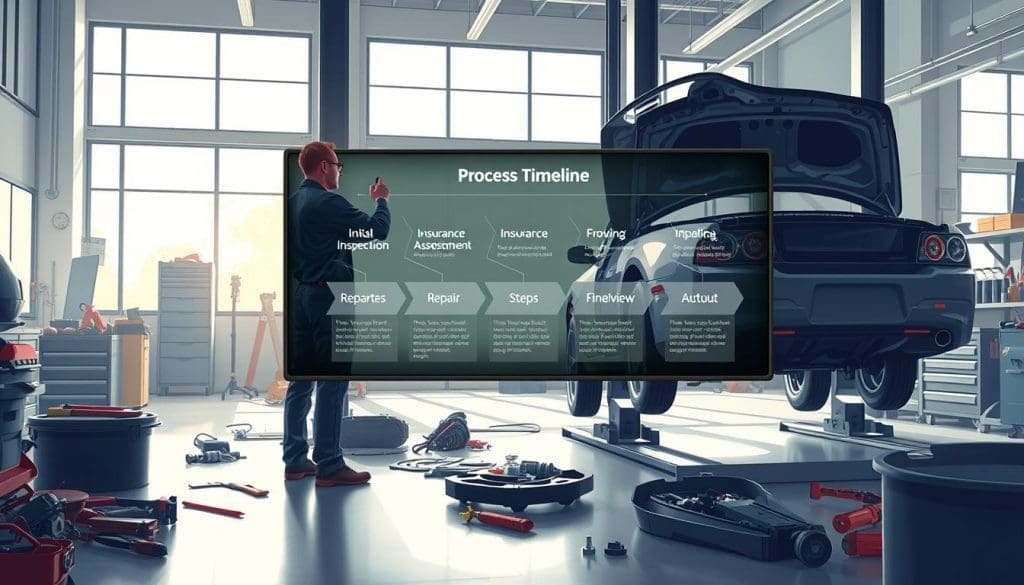
Your vehicle’s journey back to the road involves several coordinated steps. Once you schedule an appointment, you will authorize the necessary work and pay your deductible directly to the facility.
Some service centers offer convenient pickup and delivery for your car. This eliminates transportation hassles once the restoration is successfully completed.
Timeline for Repairs and Vehicle Pick-Up
After you authorize the fixes, the shop begins the labor to restore your automobile to its pre-accident condition. You should receive a clear timeline for completion. This allows you to plan your transportation needs accordingly.
During the service process, technicians may discover additional damage. This requires further approval from your insurance provider. Maintaining open communication helps ensure any delays are addressed quickly.
Once the work is finished, inspect your car thoroughly. Ensure all tasks were completed to your satisfaction before you leave. For a detailed look at a typical timeline for collision repairs, explore our dedicated resource.
| Repair Phase | Typical Duration | Key Actions |
|---|---|---|
| Initial Assessment & Scheduling | 1-2 Days | Vehicle drop-off, estimate review, authorization. |
| Parts Ordering & Preparation | 2-5 Days | Ordering components, disassembly, uncovering hidden damage. |
| Body Work & Painting | 3-7 Days | Frame correction, panel replacement, painting, drying. |
| Reassembly & Quality Control | 1-2 Days | Reinstalling parts, detailed inspection, test drive. |
Understanding these phases helps manage your expectations. It turns a complex process into a predictable series of events for your vehicle.
Conclusion
Successfully managing your car’s restoration hinges on preparation and choosing the right partner. Knowing your rights and documenting the incident makes the entire process much easier.
By selecting a reputable service center, you ensure your motor vehicle receives the quality work it deserves. We invite you to hire Miracle Body and Paint Collision Center to fix your collision damage and restore your car’s original value.
With two locations in San Antonio, our team is ready to help you manage repair costs and deal with insurance companies effectively. Visit our North West San Antonio – Leon Valley shop at 6217 Grissom Rd. or call (210) 680-1987 for expert assistance.
You can also visit our North East San Antonio location at 4650 Walzem Rd or call (210) 858-3630 to get your car fixed today.