


Professional Auto Paint Repair in San Antonio: How Shops Match Factory Paint Colors
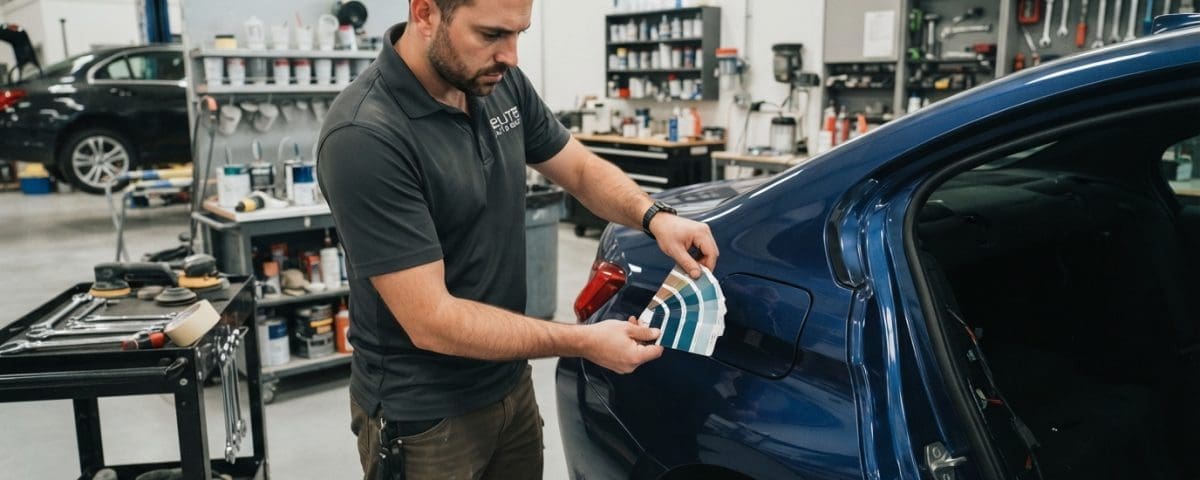
Car paint matching matters after a collision because a repaired panel can still draw your eye if its finish looks different from the rest of your vehicle. A visible color change can make the body repair stand out, even when the damaged panel fits and works as it should. The color matters because you see the repaired area every time you walk up to your car.
A close-looking finish depends on more than choosing the factory color identifier. Technicians also compare the existing finish, prepare the repair area, and apply paint with care. This guide focuses on collision repairs, not just small cosmetic touch-ups for chips or scratches. You will learn what affects the result and what to ask before choosing a collision repair shop. First, technicians need a sound starting color.
Key Takeaways
- The paint code points to the original factory formula.
- The vehicle’s current finish may differ from its original shade.
- Test panels help check color before the car is sprayed.
- Careful blending can help new paint transition into old paint.
- Ask how the shop checks and inspects a collision repair.
How Does Car Paint Matching Work?
A technician usually starts by identifying the vehicle’s factory paint code. A paint code is a manufacturer-assigned identifier tied to the original finish formula. It gives the repair a starting point, but the original formula alone cannot confirm the vehicle’s current shade.
Technicians compare the code with the vehicle’s finish before settling on a formula. A code may point to one factory color, while real-world versions of that color can vary. Records and color charts help narrow the choice, but the car itself remains the key reference.
Find the manufacturer’s paint code
Check the door jamb and the vehicle identification plate first. A paint code label may also sit on the firewall or inside the glove box, and locations vary by manufacturer. The label might show a color code among other vehicle details.
If you cannot find it, the manufacturer’s website or selling dealer may retrieve a paint code from the VIN. A car paint match by VIN can identify the factory code, but it cannot show the shade your vehicle has today. The VIN lookup is useful for records, not a direct color reading.
Use color charts to compare real-world variants
Color chips and variant decks show different versions linked to a paint code. A technician can compare their swatches with the vehicle and select a likely starting variation. A car paint matching color chart can help you understand the available versions, though printed or screen colors do not replace a physical check.
A car paint matching chart is most useful when it shows multiple swatches for one code. Those variations account for differences among factory paint runs and finishes. The selected swatch still needs comparison with the actual vehicle before repair work begins.
| Method | What it provides | What it cannot establish |
|---|---|---|
| Paint code | Original factory formula | Current shade of aged paint |
| Variant deck or color chart | Swatches for possible versions | Exact match on the vehicle |
| VIN lookup | Factory paint code | Changes to the current finish |
Check the vehicle itself, not only its records
The label’s location is not universal, so check your vehicle’s own markings before looking elsewhere. If the label is missing or hard to read, a manufacturer or dealer may use the VIN to find the code. The code points to the original formula, not a guarantee about the present finish.
That distinction matters when a repair must meet paint that has seen years of use. The factory reference narrows the search, while the vehicle’s surface shows what the repair needs to match. Next, consider why that surface may no longer look factory-new.
Why Can the Same Paint Code Look Different?

Two vehicles carrying the same code can still show slight differences in the finished color. Small changes add up, so a technician may need to adjust the formula to match your vehicle’s present surface. The paint code cannot account for every production difference or later change.
Color has three basic parts: hue is the basic color, value is how light or dark it looks, and chroma is its intensity. Matching these traits takes more than reading a code or comparing a screen image. Current conditions matter as much as the original record.
Small production and application differences
Automotive paint can vary slightly from one pigment batch to another. Application conditions and the drying process can also shift how the final color looks. Those variations may be subtle, yet they can stand out when a new panel sits beside an older one.
| Cause | What can vary | Why the code is not enough |
|---|---|---|
| Pigment batches | Hue and color intensity | One code may cover slight batch shifts |
| Application and drying conditions | Shade and metallic appearance | Factory process can change the result |
| Environmental exposure | Lightness and surface reflectivity | The code records the original finish |
Sunlight, weather, and years of use
Sunlight, weather, pollution, and maintenance can fade or change paint over time. The amount of exposure differs across a vehicle, so one panel may look unlike another. A car stored outside may show different wear from one kept in a garage.
A spectrophotometer measures reflected light at different wavelengths and gives the technician a starting point for a paint formula. It is a measuring tool, not an automatic promise of a perfect match. A car paint matching app may help with code lookup, but a screen image cannot prove a match against faded vehicle paint.
The cause of a mismatch shapes the next steps. Technicians use surface checks and test panels to account for those differences before spraying the repair.
What Needs to Be Controlled Before Spraying?
A correct formula cannot compensate for a repair surface or undercoat that changes how the finish looks. Preparation affects color because rust, damaged old paint, and filler can change how a panel absorbs or reflects light. The primer color can also shift the brightness or depth of the topcoat.
OEM means original equipment manufacturer, the maker of the vehicle or its parts. OEM paint describes the factory finish, but new OEM automotive paint does not promise a match to an aged surface without testing. Technicians need to check the repair area and test the planned materials together.
Prepare the repair area and choose the primer
Rust and loose paint need attention because they can disrupt the surface below the new finish. Filler can absorb or reflect light differently from nearby metal. A primer that differs in color can make the topcoat seem lighter, darker, or less deep, even when the formula is right.
Shop conditions also affect the paint process. The product maker sets the mixing ratio, and 2:1 and 4:1 are examples, not universal directions. Reducer choice may depend on shop temperature and humidity, so technicians should follow the product instructions.
Mix the formula and test it before using it on the vehicle
A test panel lets the technician compare the planned formula with the vehicle before painting the repair. For a useful test, the panel should follow the same materials and steps planned for the job:
- Apply the same primer and sealer planned for the repair.
- Spray the panel with the intended application setup.
- Dry or cure it under the planned repair conditions before comparing it with the vehicle.
The test only helps when its surface and treatment reflect the repair plan. A panel sprayed over a different primer may appear unlike the finished vehicle, even with the same paint formula. After testing, technicians can focus on applying the color and blending its transition into nearby paint.
How Do Technicians Apply and Verify the Match?

Even a carefully selected formula can look wrong if the paint is applied unevenly. A steady spray pattern and a controlled blend help the new finish transition into existing paint. How the color is laid down matters, especially on metallic and pearl finishes.
Spray settings depend on the paint product, so technicians follow its guidance. A typical HVLP base-coat setup may use around 10 PSI at the air cap. Base-coat nozzles commonly measure 1.2 to 1.4 mm, with the gun held 6 to 8 inches away and passes overlapping about 50 percent.
Apply evenly and blend into adjacent paint
Uneven gun distance or speed can leave stripes, blotches, or uneven metallic orientation. A blend moves fresh paint into existing paint, softening the change across panels. This step needs particular care with metallic and pearl colors because their flakes can look different as they lie in the finish.
Flash time between coats matters, too. A second coat applied too soon can cause solvent pop or uneven texture. Waiting too long can affect texture or adhesion, so technicians follow the product’s timing instructions.
Inspect the cured finish under more than one light
Technicians can inspect the cured paint in direct sunlight, overcast conditions, and fluorescent shop lighting. Each setting reveals color and surface details in a different way. No single light check catches every issue, so more than one view helps.
| Technique or check | Purpose | Important limitation |
|---|---|---|
| Consistent spray passes | Keep coverage and metallic lay even | Product settings and timing vary |
| Blending metallic or pearl paint | Ease the change into existing paint | Flake appearance can shift by angle |
| Inspecting under multiple light sources | Check color and finish in varied light | No one light reveals every flaw |
A ceramic coating is not a color-matching step. It can change surface reflectivity, which affects how the finish looks, but it cannot fix a major color mismatch. Once the repair has been checked, you can use a few direct questions to compare collision repair shops.
How Should You Choose a Collision Repair Shop?
For a collision repair, ask how the shop checks and verifies the color rather than relying on its paint code alone. Good answers describe a process that compares the current finish, tests the color, and checks the repair after it cures. The best car paint matching combines a suitable formula, comparison with your vehicle, and skilled application.
No process can promise a perfect match in every condition. Still, a shop should be able to explain how it handles color and what it will inspect. Searching for car paint matching near me can help you find a local collision repair shop to contact.
Automotive paint supply is different from collision repair. A paint supplier sells products, while a collision repair shop fixes damage and refinishes vehicle panels. Ask these questions when you compare shops:
- How do you check the existing finish?
- Do you test the color before spraying the vehicle?
- How do you blend paint into adjacent panels?
- How do you inspect the repair after the paint cures?
The answers can show whether the shop plans to check more than the factory code. You can also ask which paint products it uses and how it will explain any limits in the expected color match. A clear repair-specific estimate should spell out the planned work.
High-quality touch-up paint pens cost about $13 to $25 for minor chips. That price is for small touch-up paint, not a collision repair or a full-panel refinish. Collision repair costs depend on the damage and required work, so request an estimate for your vehicle.
Miracle Body and Paint Collision Center has two San Antonio locations. North West San Antonio, Leon Valley is at 6217 Grissom Rd., San Antonio, TX 78238, and the phone number is (210) 680 -1987.
The North East San Antonio location is at 4650 Walzem Rd, San Antonio, TX 78218, and the phone number is (210) 858-3630. Contact the location that works for you, and hire Miracle Body and Paint Collision Center to fix the collision damage on your vehicle.
Conclusion
A good color match starts with the vehicle’s finish as it looks today, not just its factory record. Check the surface rather than assuming the paint code tells the whole story. That choice helps set a realistic goal for your collision repair.
Skilled preparation and application matter to a repair that looks continuous with nearby panels. Contact Miracle Body and Paint Collision Center to discuss your vehicle’s damage and repair needs. Hire Miracle Body and Paint Collision Center to fix the collision damage on your vehicle.

