


Automatic Braking and Lane Assist: What Happens If Calibration Is Skipped?

After a collision, have the restraint system inspected and replace any deployed airbag before driving again. Airbag repair after accident damage must address safety faults, not just visible damage. The supplemental restraint system (SRS) is the network of airbags, sensors, seat belts, and controls that provides extra protection during a crash.
A vehicle may look repaired and start normally, yet its restraint system may still have a fault. A warning light, damaged trim, or past collision can point to a problem that needs a closer check. You need a clear inspection before trusting the system to protect you.
Treat a persistent airbag warning light as a reason to stop and arrange an SRS inspection.
Key Takeaways
- Replace every deployed airbag before driving.
- Have the full SRS checked, not just the visible damage.
- A warning light going out does not prove the repair is complete.
- Keep the scan reports and repair record with your vehicle documents.
- Ask a qualified collision shop to inspect any unclear repair.
Why Airbags Deploy in Some Crashes
Two crashes at similar speeds can produce different airbag outcomes because the system responds to the impact and the vehicle’s design. Speed alone does not decide deployment, and airbags are not meant to deploy in every crash.
Airbags can open in less than 1/20th of a second. Frontal and side airbags are generally designed for moderate to severe crashes, though a minor crash may also trigger them.
What determines deployment
The airbag control module uses crash data from sensors to judge the event. It weighs factors such as impact direction, speed, the vehicles involved, system design, and crash-sensor locations.
A vehicle may record an impact differently from another vehicle in the same collision. Sensor placement and the angle of impact can change the data that reaches the module. That is why the damage you see does not always match the airbag response.
Airbags deploy only once. They supplement seat belts, which help hold you in place as the bags open and cushion you.
What deployment means for the restraint system
When an airbag deploys, the unit cannot be repacked or reused. Replace each deployed airbag with a proper replacement part, and have the rest of the restraint system checked for faults or impact damage.
The module and sensors may also need attention after a deployment event. A visual check alone cannot show every fault, since the system may store crash data or fault codes.
Frontal airbags have saved more than 50,000 lives over a 30-year period. Their protection depends on working parts and proper use, not on the airbag alone.
Keep wearing your seat belt because airbags are designed to work with it, not instead of it.
Can You Drive After Airbags Deploy?
No, do not drive a vehicle after an airbag deploys until the deployed unit has been replaced. A car with a blown airbag needs an SRS inspection before you drive it. Do not drive it until an authorized repair center completes the work.
A deployed airbag must be replaced before the vehicle returns to the road. The airbag module and other restraint parts may also need attention, based on inspection findings.

After airbags deploy, have the vehicle inspected before driving again. A mechanic checks the deployed airbag module to assess the safety system.
When a vehicle should stay parked
A separate inflator risk affects some replacement airbags. As of September 3, 2026, 14 crashes involving vehicles fitted with DTN60DB replacement inflators had caused 11 deaths and three severe injuries.
A vehicle with a DTN60DB inflator should not be driven until a shop replaces it with genuine original-equipment parts. As of that date, these inflators had been found in Chevrolet Malibu, Hyundai Sonata, and Chevrolet Equinox vehicles. There is no indication that the risk is limited to those models.
A vehicle history report cannot confirm whether this inflator is installed. Only an in-person inspection can establish that, and the owner pays for DTN60DB inspection and replacement.
Ask for an in-person check if the vehicle has any of these flags:
- A prior airbag deployment
- A previous crash or total-loss event
- A reported theft
- Repairs at a non-certified service center
The DTN60DB inflator risk
Do not try to open an airbag module or remove an inflator yourself. Airbags can deploy during handling and cause serious injury or death.
Tell the repair shop about any known collision, repair, or theft history. Those details can help the shop focus its inspection, but they do not replace a physical check.
Never dismantle an airbag yourself to look for an inflator or confirm a deployment history.
Airbag Repair After Accident: What the Work Involves
A complete airbag repair starts by identifying which restraint components fired and which were damaged in the collision. The repair plan should come from a diagnostic scan and physical inspection, not from replacing only the visible bag.
A complete repair may include airbags, sensors, the airbag control module, and damaged interior parts. The needed work depends on the diagnostic findings for that vehicle.
Scan the restraint system and map damage
An SRS diagnostic scan can find faults that a visual check may miss. The shop checks the crash data, fault codes, sensors, wiring, and impact areas, then compares those findings with physical damage.
This process helps show whether the crash affected parts beyond the deployed airbag. A steering wheel or dashboard may look intact while a sensor or control part still has a fault.
Replace deployed components
Airbags are single-use parts, so a deployed unit needs replacement. The shop also checks crash sensors and the airbag control module, replacing or repairing parts when inspection results call for it.
The table shows common parts a shop may review. Not every collision requires work on every row.
| Component | What the shop checks or repairs | Why it matters |
|---|---|---|
| Deployed airbag | Replacement of each fired unit | A deployed unit cannot protect you again |
| Crash sensors | Damage, faults, and correct operation | Sensors help detect and report an impact |
| Airbag control module | Stored data, faults, and module condition | The module controls restraint-system response |
| Dashboard, steering wheel, or interior | Damage to trim, covers, and related areas | Damaged parts may affect fit or safe operation |
Restore the module and damaged interior
The airbag control module may need repair or replacement after a collision. A reset alone does not replace a deployed airbag or fix other damaged components.
Ask the shop to explain any proposed module work in relation to the scan results. The same applies to dashboard, steering wheel, or interior repairs, especially when damage is hidden behind trim.
Ask for an itemized estimate that connects each proposed part or repair to a diagnosed condition.
Verify the SRS Repair Before Driving
A dashboard light going out is not proof that every airbag and sensor is ready to work. A proper SRS scan can show faults that a basic engine scan may not read.
Clearing a code without fixing its cause is not a completed repair. Ask for scan results and a written record of the work done.
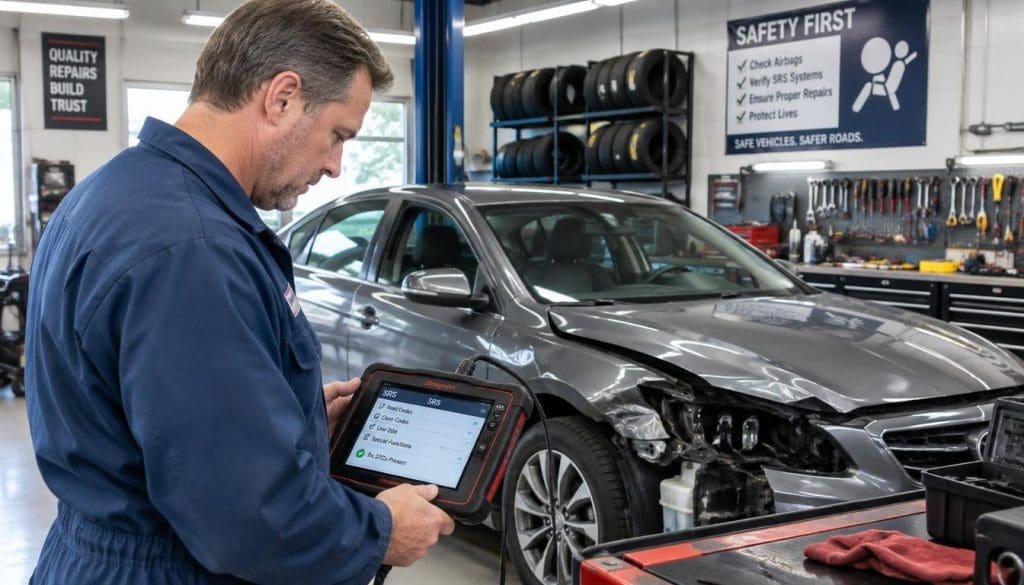
Before driving after a collision, have the SRS system checked with a scan tool to verify the airbag repair and functionality.
Check the system with the right scan
AutoZone’s generic engine-code scan may not read SRS fault codes. Ask whether the scan tool can check the restraint system on your specific vehicle.
Professional collision diagnosis uses a compatible scan tool to retrieve SRS fault codes. The tool needs to communicate with the vehicle’s SRS, not just its engine controls.
A warning light that turns off by itself does not show that the system is fully repaired. The shop should check the light against the vehicle’s service procedure.
Review the completed repair record
Use these four checks before you accept the vehicle:
- SRS scan results are recorded.
- Repairs match the faults the scan and inspection found.
- Every deployed component has been replaced.
- The warning light was checked against the vehicle’s service procedure.
The record should name the parts and repairs, rather than say only that the airbag system was checked. It should also show what the scan found before and after the work.
| Check | What to ask for | What it helps confirm |
|---|---|---|
| SRS scan | Before-and-after scan reports | Fault codes were read and reviewed |
| Parts and repairs | Itemized repair record | Work matches identified faults |
| Warning light | Result of the service-procedure check | The light status was checked correctly |
Keep the before-and-after scan reports and the itemized repair record with your vehicle documents.
Will Insurance Total a Car After Airbag Deployment?
Airbag deployment by itself does not make your car a total loss. The insurer compares repair costs with the vehicle’s pre-crash actual cash value (ACV). That comparison, not deployment alone, guides the decision.
Whether the vehicle is worth fixing depends on the estimate and its ACV. The number of airbags, labor, sensors, module work, and interior damage can all affect the bill.
How insurers assess a total loss
The insurer looks at the cost to repair collision damage and compares it with the vehicle’s ACV before the crash. A vehicle may be repairable after deployment if its damage and repair cost support that choice.
Ask how the insurer reached its ACV and which repair items it included. The estimate should account for needed restraint work as well as other collision damage.
What coverage and repair costs can mean
As broad planning figures, driver-side airbag replacement estimates range from $1,000-$1,500. Passenger-side estimates range from $1,200-$2,000.
Full-system replacement estimates range from $3,000-$6,000 or more. Severe collisions or luxury vehicles may reach $10,000 or more.
Labor estimates run $200-$600. A control module or impact sensors may add $300-$1,000 in some cases. More deployed airbags and interior damage can raise the total.
Collision coverage may pay for covered repairs, subject to your policy and deductible. A covered manufacturer recall repair is handled through the recall remedy, not as ordinary collision work.
Ask the insurer to explain the repair estimate and ACV comparison before you decide whether to proceed.
Conclusion
Your car is ready to return to the road only after the restraint system has been repaired and checked. A warning light alone cannot confirm that every part works, and a deployed restraint needs proper replacement.
If no qualified professional has checked the SRS since the collision, arrange an inspection with a collision-repair professional. Keep the repair record so you can show what the shop found and fixed.
If you are uncertain about the repair, arrange a professional SRS inspection before driving.

