


What to Do After a Car Accident in San Antonio: A Checklist for Drivers

After a collision, you may need ADAS calibration whenever repair work could have shifted, damaged, or replaced a camera, radar unit, or other sensor. ADAS calibration San Antonio services can check whether your vehicle needs work under its maker’s procedure.
Advanced driver assistance systems (ADAS) use cameras, radar, and other sensors to support drivers. Forward collision warning alerts you to a possible crash, while automatic emergency braking applies the brakes to avoid or reduce an impending forward crash. Neither feature replaces your attention behind the wheel.
NHTSA reported 39,254 motor vehicle crash deaths in the United States in 2024. That figure gives sober context, but calibration does not guarantee crash prevention. Accurate sensor information helps your vehicle’s features respond as designed. Keep monitoring the road yourself even when your vehicle’s assistance features are active.
Key Takeaways
- A collision may shift or damage a camera, radar unit, or sensor.
- Repair work can create a need for a vehicle-specific calibration check.
- Forward collision warning alerts you, while automatic emergency braking can apply the brakes.
- Driver assistance features support you but do not replace attentive driving.
- Your vehicle maker’s procedure determines the required calibration work.
Why Collision Repairs Can Disrupt ADAS Sensors
A repair can affect ADAS even when the visible damage is small, because the calibration requirement depends on the vehicle and the work performed. A camera may need attention after windshield work, while sensors near a bumper may shift during body repair. Small changes matter when a system relies on measured angles and distances.
Only the vehicle-specific OEM procedure determines whether calibration is required. OEM procedure means the vehicle maker’s calibration instructions. Your vehicle’s make, model, year, sensor type, and repair operation all affect that decision.
Windshield camera recalibration may be required after windshield repair or replacement to restore OEM specifications. Body repairs, wheel alignment, suspension or steering work can also affect sensor aim or vehicle geometry. A warning or unusual feature behavior merits a check, but it does not identify the needed procedure by itself.
| Repair event | Component that may be affected | What to check |
|---|---|---|
| Windshield repair or replacement | Camera | Whether the OEM procedure calls for camera recalibration |
| Bumper or grille repair or replacement | Mounted sensors | Sensor location and required calibration steps |
| Wheel alignment or suspension and steering work | Sensor aim or vehicle geometry | OEM requirements after the work |
Windshield cameras can sit behind the glass, where damage may not be easy to spot. A new windshield can also change the camera’s position or view. That is why a glass invoice alone cannot confirm that the system meets its maker’s specifications.
The I-CAR OEM Calibration Requirements Search covers 2016-and-newer vehicles. You can search by year, make, model, affected system, or repair event. Check the I-CAR OEM search for 2016-and-newer vehicles, then confirm the procedure against the vehicle maker’s instructions.
What Does ADAS Calibration San Antonio Include?
A complete service starts by identifying the affected system and following the OEM procedure, then calibrates and checks the system as that procedure requires. The work may include a pre-repair diagnostic scan, calibration, required resets, and a post-calibration verification. The vehicle’s own requirements guide each step.
A cleared warning light alone does not prove that a camera or sensor points accurately. The repair record and vehicle details help a technician select the correct process for advanced driver assistance systems.
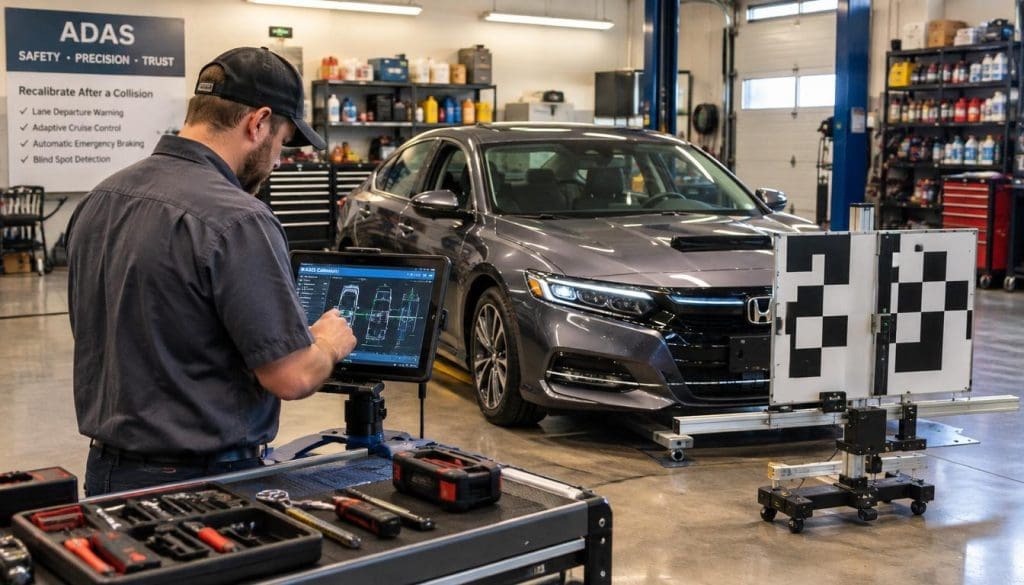
ADAS calibration in San Antonio includes adjusting safety sensors with specialized equipment, as a technician does on this modern sedan.
Pre-repair scans and vehicle-specific requirements
A pre-repair diagnostic scan checks stored vehicle faults before repair. I-CAR and several OEM position statements call for this scan on ADAS-equipped vehicles before collision repair, glass replacement, sensor-area work, electrical work, or module replacement.
The scan can show faults tied to a system before work begins. It also gives the repair team a record to compare with later results. A scan does not replace the specific calibration steps set by the maker.
Some reset commands require manufacturer-specific scan-tool functions. A generic OBD-II scanner may read common fault codes but cannot always run those commands. This matters when a repair or replacement changes a module’s status.
To help match the check to your vehicle, share:
- Vehicle year, make, and model
- The repair or replacement performed
- Warning messages or unusual feature behavior
Calibration followed by system verification
The technician performs the calibration required by the OEM procedure. The system may need a reset or more than one calibration step, depending on the vehicle’s design.
Afterward, a post-calibration verification checks for stored faults and confirms the required steps were completed. The technician should assess the system, not simply clear a dashboard warning. A warning can disappear even when the underlying sensor aim remains incorrect.
Verification also gives you a clearer record of the work. Ask for details about the calibration performed and any remaining fault that needs attention. This helps separate a completed calibration from a system that still needs diagnosis.
A camera, radar unit, or other sensor may have its own procedure, even when several features share information. Share the repair details and any dashboard warnings so the technician can match the check to the work performed.
Static and Dynamic Calibration Follow Different OEM Procedures
Static calibration is performed with the vehicle stationary, while dynamic calibration requires a drive under conditions specified by the OEM. Static calibration is a stationary procedure that aligns an ADAS sensor or camera to a target positioned at OEM-specified measurements. The required method depends on the vehicle.
Some vehicle platforms require static calibration followed by dynamic calibration, in the order specified by the OEM procedure. The table compares the methods, but it cannot replace the procedure for your vehicle.
| Procedure | Vehicle setup | Key requirements | What can affect completion |
|---|---|---|---|
| Static | Vehicle stationary | Target board at OEM-specified distance and height; level floor | Incorrect target position or uneven floor |
| Dynamic | Vehicle driven on road | OEM-specified speed and visible lane markings | Weather, sun glare, road quality, or unclear lane markings |
| Combined | Static followed by dynamic | Both methods in OEM-specified order | Any setup or road condition that affects either method |
For a static calibration, the vehicle stays in a controlled space while a technician positions the target. The target’s height and distance matter because the camera or sensor reads its location. A level floor helps keep the vehicle and target aligned.
Dynamic calibration uses a road drive. The vehicle must reach the speed set by the OEM, and the road needs clear lane markings. Weather, poor road quality, sun glare, or faded lane lines can stop the process from completing.
Some systems need both methods, and the required order matters. A combined procedure may start with a stationary target setup, then use a road drive to complete calibration. A successful result depends on each required step, not just one part of the process.
The table is a guide to the method, not a substitute for checking your vehicle’s own procedure. Ask whether the required procedure includes one method or both, and whether the road conditions are suitable for a dynamic run.
Cost, Timing, and Insurance Depend on Different Factors
The estimate depends on the vehicle and required procedure, while the insurer’s policy and claim terms determine whether calibration is covered. There is no single fee that fits every vehicle, because systems and repair needs differ.
The OEM procedure determines which calibration work is required. Your insurer’s policy and claim determine whether that work qualifies for coverage.
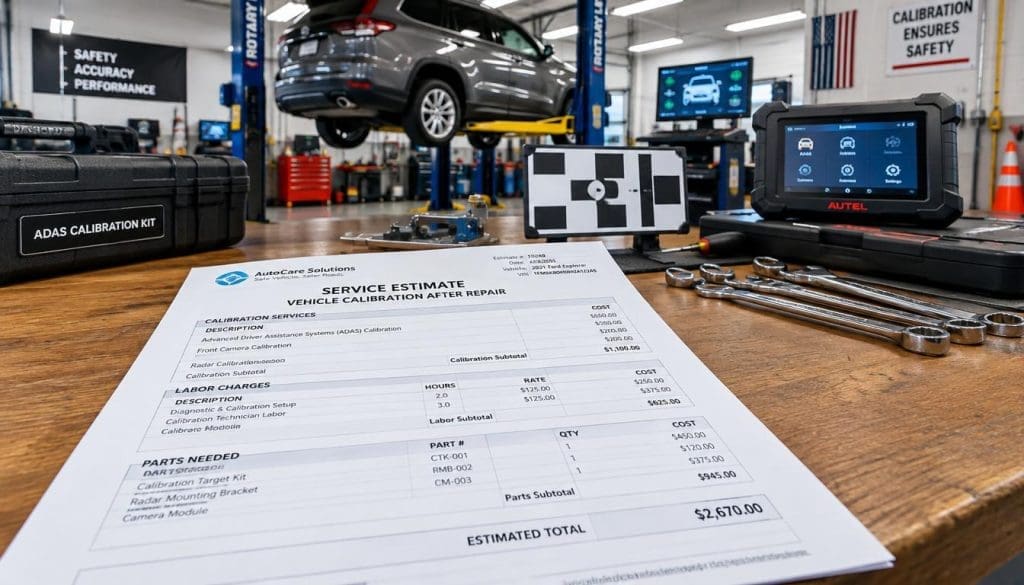
Calibration costs depend on labor, parts, and the work required after a collision, so review the estimate before repairs begin.
What determines the estimate
The estimate can change with your vehicle’s make and model, the sensors or systems involved, the repair operation, and the required procedure. A vehicle with more affected systems may need more work than one with a single camera check.
The shop must match the work to the OEM procedure rather than charge one flat fee for every vehicle. The procedure can call for a static calibration, a dynamic calibration, or both. It may also call for diagnostic checks and system verification.
Ask which systems the estimate covers and whether it includes all required steps. A clear estimate should identify the planned work instead of listing only a general calibration charge. That detail helps you compare the estimate with the repair performed.
Scheduling time and insurance approval
Each static or dynamic recalibration may take one or more hours, depending on your vehicle’s make and model. Setup needs and road conditions can affect the schedule, especially when a dynamic drive is required.
A shop may need more time if road conditions interrupt a dynamic calibration. The full visit can also include checks before and after the calibration. Ask whether the time estimate covers the whole service or only the calibration step.
Insurance may cover calibration as part of an eligible collision or glass claim. Coverage and authorization depend on your policy and claim, so do not assume the work is covered. Contact your insurer about approval before authorizing service.
Keep the estimate and claim details together while you confirm the work. The insurer may need the repair information to decide whether calibration belongs under the claim. Confirm the estimate, expected appointment duration, and claim authorization before approving the work.
Prepare for Your Calibration Appointment
Before arranging service in San Antonio, gather your vehicle details and a clear description of the repair that may have affected its sensors. Those details help a provider check the manufacturer’s requirements for your vehicle.
Choose a provider that follows the vehicle-specific OEM procedure and verifies the result. ADAS calibration services may be offered by a dedicated calibration facility, an auto glass shop, or a collision repair facility.
Contact Miracle Body & Paint to arrange a vehicle-specific ADAS calibration assessment. Be ready to share your vehicle’s year, make, and model, the recent repair or replacement, and any warning messages.
Bring repair paperwork if you have it. A work order can name the part replaced or the area repaired, which helps the technician review the right system. Note when a warning first appeared and whether a feature behaves differently.
Before you book, ask:
- Which calibration procedure does my vehicle need?
- Does the appointment include a post-calibration check?
- What documentation will I receive?
A dedicated facility, glass shop, or collision repair facility may each handle the work. The important point is that the provider follows the applicable OEM procedure and checks the result, rather than stopping after a reset.
Keep the answers with your appointment details. They can help you understand what the service includes and what records you will receive. Confirm that the appointment is for the calibration your vehicle requires, not just a general warning-light reset.
Conclusion
Accurate ADAS operation depends on using the procedure specified for your vehicle and the repair it received. One collision does not mean every vehicle needs the same calibration, and a warning light alone cannot settle the question.
Base your next step on the repair history and the required OEM procedure. Ask a qualified provider to assess the affected system and explain the work it needs.
Driver assistance features can support your driving, but they do not take over your responsibility for safety. Keep the calibration documentation with your repair records and continue to monitor the road yourself.

